
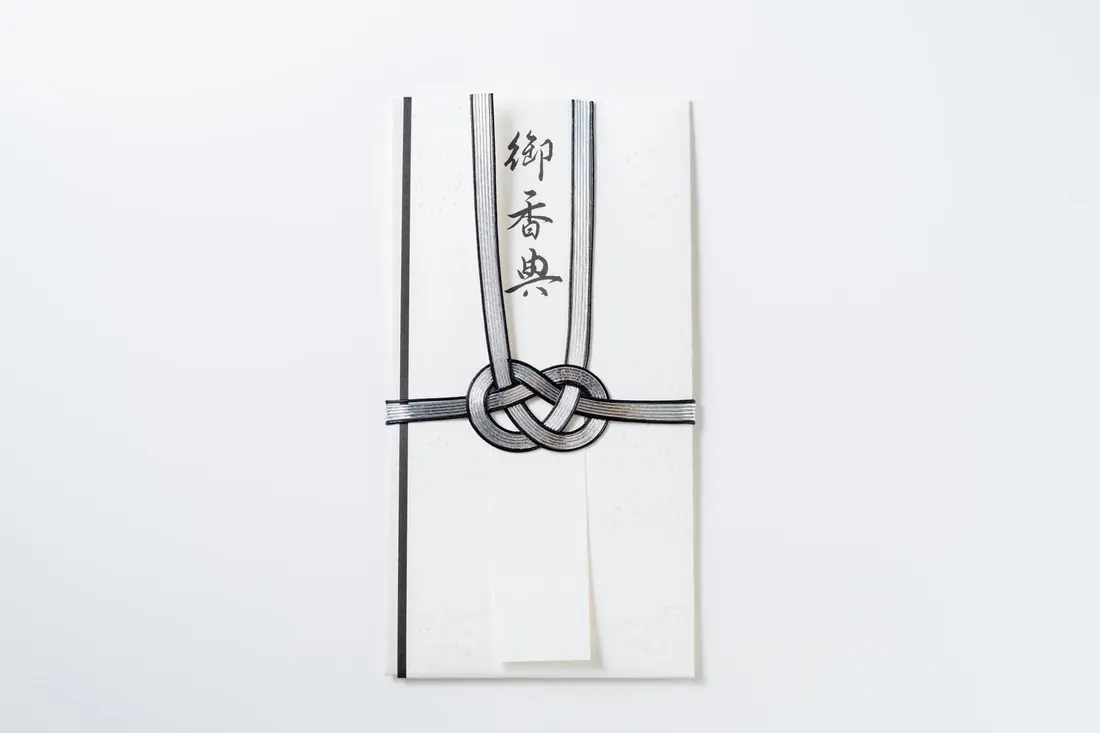
Choose your situation below to see a typical amount right away.
Steps 2-5 walk you through choosing, writing and handing over the envelope.
Step 1: Check the typical amount
Typical koden amount
5,000円
The amounts shown here are general reference figures only. Appropriate amounts differ by region, relationship and local custom. Before deciding on an actual amount, we recommend checking with your family or people around you.
Step 2: Match the envelope to the amount
The rule of thumb: the envelope's formality should match the amount inside. A luxurious envelope around a small amount looks unbalanced.
- Up to 5,000 yen: an envelope with a printed mizuhiki cord is fine.
- 10,000-30,000 yen: a real black-and-white mizuhiki cord (musubi-kiri / awaji knot).
- 30,000 yen and above: silver-silver cords or premium washi paper.
See Choosing a Koden Envelope for cord colors and designs. Find koden envelopes Find silver-cord envelopes
Step 3: Write the inscription and your name
The front inscription (written on the upper half) depends on the family's religion and on whether it is the wake/funeral or a later memorial service.
御霊前
Diagram: where everything goes
Writing rules
- Use light ink (usuzumi) for the wake and funeral - it symbolizes ink diluted by tears. Normal black ink is used from the 49th-day service onward. Find light-ink brush pens
- Write your full name centered below the cord.
- Married couple: husband's full name in the center, wife's given name to its left.
- Work-related: add the company name in smaller writing at the upper right of your name. Up to three joint names are fine (most senior on the right); four or more become "(company) 一同" (ichido, "all of us").
Step 4: Fill in the inner envelope and insert the bills
Inner envelope
Write the amount in the center of the inner envelope's front, and your address and name at the lower left of its back. Formal amounts use traditional numerals (daiji).
| Amount | Formal writing |
|---|---|
| 5,000 yen | 金伍仟圓 (金五千円 also accepted) |
| 10,000 yen | 金壱萬圓 |
| 30,000 yen | 金参萬圓 |
| 50,000 yen | 金伍萬圓 |
| 100,000 yen | 金拾萬圓 |
Inserting the bills
- Insert bills with the portrait facing the back of the envelope, head downward - said to represent a face lowered in grief.
- Align all bills the same way.
- Avoid brand-new bills; fold them once if that is all you have.
If the envelope has no inner envelope, write the amount and address on the back of the envelope itself.
Step 5: Wrap it in a fukusa and hand it over
Never carry the envelope loose in a bag or pocket - wrap it in a fukusa cloth. For funerals use cool colors: purple, navy or gray. Purple works for both happy and sad occasions, so one purple fukusa covers everything. Find a fukusa cloth
- Wrapping: for funerals, the fukusa should open from the left (the reverse of celebrations).
- When: hand it over at the reception desk when signing the guest book. If you attend both the wake and the funeral, give koden at only one of them - giving twice evokes "misfortune repeating".
- How: take it out of the fukusa, turn it so the recipient can read the inscription, and offer it with both hands, quietly saying "Konotabi wa goshusho-sama desu" (my condolences).
The reception flow and incense offering are covered in Funeral Manners: Incense & Etiquette.
Related pages
PR — This page contains promotional content
Frequently asked questions
How much koden should I give?
Around 5,000 yen for a friend or acquaintance, and 10,000-50,000 yen for relatives, are common reference figures. The amount shifts with closeness, your age, and regional or family custom.
What is the difference between 御霊前 and 御仏前?
御霊前 (go-reizen) is used at the wake and funeral, before the 49th day; 御仏前 (go-butsuzen) from the 49th-day service onward. Jodo Shinshu, however, uses 御仏前 from the funeral itself.
Why write in light ink?
Light ink (usuzumi) is said to represent ink diluted by tears of grief. Use it for the wake and funeral, and normal black ink for memorial services from the 49th day onward.
Can I use brand-new bills?
No - new bills suggest you prepared them in anticipation of the death. If you only have new bills, fold them once before inserting.
Why avoid amounts with 4 or 9?
Four (shi) sounds like death and nine (ku) like suffering. Give round amounts such as 3,000, 5,000, 10,000 or 30,000 yen.
We are attending as a couple - how does koden work?
One koden per household. Write both spouses' names (or just the household head's) and give roughly the same amount as a single attendee, or somewhat more if you both join the meal.
